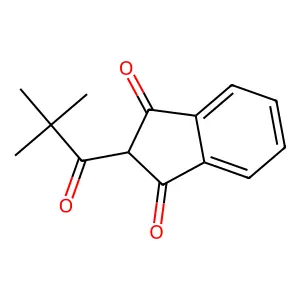
杀鼠酮 structure

杀鼠酮

TL;DR: 杀鼠酮 (CAS 83-26-1) is a chemical compound with molecular formula C14H14O3 and molecular weight 230.09 g/mol, supplied by Kehong Biological (Henan Kehong Biological Technology Co., Ltd.) with CRO/CDMO custom synthesis services.

杀鼠酮

2-(2,2-dimethylpropanoyl)indene-1,3-dione

Also Known As: PINDONE, Chemrat, Pivalyl, Pivalyn, Pival

CAS: 83-26-1
Molecular Formula C14H14O3
Molecular Weight 230.09 g/mol
LogP 2.7
Topological Polar Surface Area 51.2 Ų
Hydrogen Bond Donors 0
Hydrogen Bond Acceptors 3
Rotatable Bonds 2
Exact Mass 230.0943
Heavy Atoms 17
Complexity 351.0
Melting Point 227.3 to 110.5 °C
Boiling Point Decomposes
Density 1.06
Solubility less than 1 mg/mL at 72 °F (NTP, 1992)
Vapor Pressure Very low

Chemical Identifiers

CAS Number 83-26-1
SMILES CC(C)(C)C(=O)C1C(=O)C2=CC=CC=C2C1=O
InChIKey RZKYEQDPDZUERB-UHFFFAOYSA-N

Patent-Derived Application Labels

Derived from 12 IPC patent classification(s) across the SureChEMBL global patent database.

Agrochemicals (136 patents) Analytical Reagents (1 patents) Biotechnology (7 patents) Food Additives (2 patents) Heterocyclic Building Blocks (20 patents) +7 more

Product Overview

杀鼠酮 (CAS 83-26-1), with molecular formula C14H14O3 and molecular weight 230.09 g/mol. IUPAC: 2-(2,2-dimethylpropanoyl)indene-1,3-dione.

🧪
Safety Data Sheet (MSDS / SDS) View the Laboratory Chemical Safety Summary (LCSS) on PubChem — includes GHS classifications, hazard statements, first aid measures, and handling precautions.
View MSDS →

Chemical Property Profile of 杀鼠酮

XLogP
2.7
TPSA (Topological Polar Surface Area)
51.2
Hydrogen Bond Donors
0
Hydrogen Bond Acceptors
3
Rotatable Bonds
2
Heavy Atoms
17
Complexity
351.0
Exact Mass
230.0943
Monoisotopic Mass
230.0943
Data Source: Chemical property values are referenced from PubChem, the world's largest open chemistry database maintained by the National Center for Biotechnology Information (NCBI), U.S. National Library of Medicine.

Property Insights of 杀鼠酮

The XLogP value of 2.7 suggests moderate lipophilicity, balancing water solubility and membrane permeability for 杀鼠酮. With a topological polar surface area (TPSA) of 51.2 Ų, 杀鼠酮 exhibits relatively low polarity, potentially indicating favorable cell membrane permeability. Following Lipinski's Rule of Five, 杀鼠酮 has 0 hydrogen bond donor(s) and 3 hydrogen bond acceptor(s), all within the drug-like range, suggesting favorable oral bioavailability potential.

Frequently Asked Questions

What is the typical lead time for this product?
Lead time typically ranges from 3-7 business days for in-stock items. For larger quantities or custom orders, please contact us for specific lead times.
Can you provide samples for testing?
Yes, we offer sample quantities for quality testing. Please submit an inquiry with your requirements and we will arrange samples accordingly.
What documentation do you provide with the product?
We provide COA (Certificate of Analysis), MSDS (Material Safety Data Sheet), and technical data sheets with each shipment.
Do you ship internationally?
Yes, we ship to most countries worldwide. Shipping costs and delivery times vary by location. Please contact us for specific shipping information.

Frequently Asked Questions

What is the CAS number of 杀鼠酮?

The CAS number of 杀鼠酮 is 83-26-1.

What is the molecular formula of 杀鼠酮?

The molecular formula of 杀鼠酮 is C14H14O3.

What is the molecular weight of 杀鼠酮?

The molecular weight of 杀鼠酮 is 230.09 g/mol.

Where can I buy 杀鼠酮?

You can request a quote for 杀鼠酮 directly from KEHONG BIO. Contact us or email info@kehongbio.com for pricing and availability.

Does KEHONG BIO offer custom synthesis for 杀鼠酮?

Yes, KEHONG BIO provides custom synthesis services for 杀鼠酮 and related compounds. Contact us with your specific requirements including quantity, purity, and timeline.

🤖 科弘生物 AI 助手 ×
您好!我是 科弘生物 AI 助手。可以问我产品搜索、询价、样品或技术问题。如何帮助您?