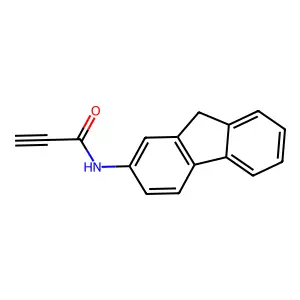
Propiolamide, N-(2-fluorenyl)-
TL;DR: Propiolamide, N-(2-fluorenyl)- (CAS 60550-90-5) is a chemical compound with molecular formula C16H11NO and molecular weight 233.08 g/mol, supplied by Kehong Biological (Henan Kehong Biological Technology Co., Ltd.) with CRO/CDMO custom synthesis services.
N-(9H-fluoren-2-yl)prop-2-ynamide
Also Known As: N- propiolamide, 2-Propynoylaminofluorene, N-(2-Fluorenyl)propiolamide, Propiolamide, N-(2-fluorenyl)-, N-(9H-Fluoren-2-yl)propiolamide
| Molecular Formula | C16H11NO |
|---|---|
| Molecular Weight | 233.08 g/mol |
| LogP | 4.1 |
| Topological Polar Surface Area | 29.1 Ų |
| Hydrogen Bond Donors | 1 |
| Hydrogen Bond Acceptors | 1 |
| Rotatable Bonds | 1 |
| Exact Mass | 233.08406 |
| Heavy Atoms | 18 |
| Complexity | 380.0 |
Chemical Identifiers
| CAS Number | 60550-90-5 |
|---|---|
| SMILES | C#CC(=O)NC1=CC2=C(C=C1)C3=CC=CC=C3C2 |
| InChIKey | QJWPHGSMDZSKOP-UHFFFAOYSA-N |
Product Overview
Propiolamide, N-(2-fluorenyl)- (CAS 60550-90-5), with molecular formula C16H11NO and molecular weight 233.08 g/mol. IUPAC: N-(9H-fluoren-2-yl)prop-2-ynamide.
Chemical Property Profile of Propiolamide, N-(2-fluorenyl)-
Property Insights of Propiolamide, N-(2-fluorenyl)-
The XLogP value of 4.1 indicates that Propiolamide, N-(2-fluorenyl)- is lipophilic (fat-soluble), which may influence its absorption, distribution, and formulation strategy. With a topological polar surface area (TPSA) of 29.1 Ų, Propiolamide, N-(2-fluorenyl)- exhibits relatively low polarity, potentially indicating favorable cell membrane permeability. Following Lipinski's Rule of Five, Propiolamide, N-(2-fluorenyl)- has 1 hydrogen bond donor(s) and 1 hydrogen bond acceptor(s), all within the drug-like range, suggesting favorable oral bioavailability potential.
Frequently Asked Questions
Frequently Asked Questions
What is the CAS number of Propiolamide, N-(2-fluorenyl)-?
The CAS number of Propiolamide, N-(2-fluorenyl)- is 60550-90-5.
What is the molecular formula of Propiolamide, N-(2-fluorenyl)-?
The molecular formula of Propiolamide, N-(2-fluorenyl)- is C16H11NO.
What is the molecular weight of Propiolamide, N-(2-fluorenyl)-?
The molecular weight of Propiolamide, N-(2-fluorenyl)- is 233.08 g/mol.
Where can I buy Propiolamide, N-(2-fluorenyl)-?
You can request a quote for Propiolamide, N-(2-fluorenyl)- directly from KEHONG BIO. Contact us or email info@kehongbio.com for pricing and availability.
Does KEHONG BIO offer custom synthesis for Propiolamide, N-(2-fluorenyl)-?
Yes, KEHONG BIO provides custom synthesis services for Propiolamide, N-(2-fluorenyl)- and related compounds. Contact us with your specific requirements including quantity, purity, and timeline.