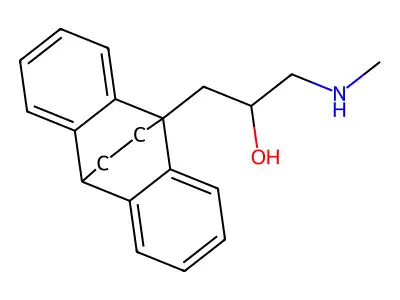
Oxaprotiline
TL;DR: Oxaprotiline (CAS 56433-44-4) is a chemical compound with molecular formula C20H23NO and molecular weight 293.18 g/mol, supplied by Kehong Biological (Henan Kehong Biological Technology Co., Ltd.) with CRO/CDMO custom synthesis services.
1-(methylamino)-3-(1-tetracyclo[6.6.2.02,7.09,14]hexadeca-2,4,6,9,11,13-hexaenyl)propan-2-ol
Also Known As: OXAPROTILINE, Levoprotiline, Levoprtiline, Oxaprotilina, Oxaprotilin
| Molecular Formula | C20H23NO |
|---|---|
| Molecular Weight | 293.18 g/mol |
| LogP | 3.6 |
| Topological Polar Surface Area | 32.3 Ų |
| Hydrogen Bond Donors | 2 |
| Hydrogen Bond Acceptors | 2 |
| Rotatable Bonds | 4 |
| Exact Mass | 293.17798 |
| Heavy Atoms | 22 |
| Complexity | 371.0 |
Chemical Identifiers
| CAS Number | 56433-44-4 |
|---|---|
| SMILES | CNCC(CC12CCC(C3=CC=CC=C31)C4=CC=CC=C24)O |
| InChIKey | FDXQKWSTUZCCTM-UHFFFAOYSA-N |
Patent-Derived Application Labels
Derived from 7 IPC patent classification(s) across the SureChEMBL global patent database.
Product Overview
Oxaprotiline (CAS 56433-44-4), with molecular formula C20H23NO and molecular weight 293.18 g/mol. IUPAC: 1-(methylamino)-3-(1-tetracyclo[6.6.2.02,7.09,14]hexadeca-2,4,6,9,11,13-hexaenyl)propan-2-ol.
Chemical Property Profile of Oxaprotiline
Property Insights of Oxaprotiline
The XLogP value of 3.6 indicates that Oxaprotiline is lipophilic (fat-soluble), which may influence its absorption, distribution, and formulation strategy. With a topological polar surface area (TPSA) of 32.3 Ų, Oxaprotiline exhibits relatively low polarity, potentially indicating favorable cell membrane permeability. Following Lipinski's Rule of Five, Oxaprotiline has 2 hydrogen bond donor(s) and 2 hydrogen bond acceptor(s), all within the drug-like range, suggesting favorable oral bioavailability potential.
Frequently Asked Questions
Frequently Asked Questions
What is the CAS number of Oxaprotiline?
The CAS number of Oxaprotiline is 56433-44-4.
What is the molecular formula of Oxaprotiline?
The molecular formula of Oxaprotiline is C20H23NO.
What is the molecular weight of Oxaprotiline?
The molecular weight of Oxaprotiline is 293.18 g/mol.
Where can I buy Oxaprotiline?
You can request a quote for Oxaprotiline directly from KEHONG BIO. Contact us or email info@kehongbio.com for pricing and availability.
Does KEHONG BIO offer custom synthesis for Oxaprotiline?
Yes, KEHONG BIO provides custom synthesis services for Oxaprotiline and related compounds. Contact us with your specific requirements including quantity, purity, and timeline.