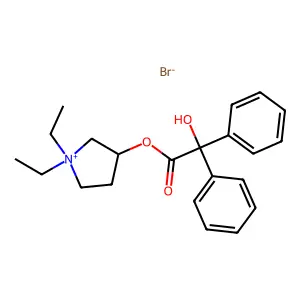
Pyrrolidinium, 1,1-diethyl-3-((2-hydroxy-2,2-diphenylacetyl)oxy)-, bromide (1:1)
TL;DR: Pyrrolidinium, 1,1-diethyl-3-((2-hydroxy-2,2-diphenylacetyl)oxy)-, bromide (1:1) (CAS 1050-48-2) is a chemical compound with molecular formula C22H28BrNO3 and molecular weight 433.13 g/mol, supplied by Kehong Biological (Henan Kehong Biological Technology Co., Ltd.) with CRO/CDMO custom synthesis services.
(1,1-diethylpyrrolidin-1-ium-3-yl) 2-hydroxy-2,2-diphenylacetate bromide
Also Known As: Benzilonium bromide, Pirbenina, Pyrbenine, Minelcin, Minelco
| Molecular Formula | C22H28BrNO3 |
|---|---|
| Molecular Weight | 433.13 g/mol |
| LogP | 0.1 |
| Topological Polar Surface Area | 46.5 Ų |
| Hydrogen Bond Donors | 1 |
| Hydrogen Bond Acceptors | 4 |
| Rotatable Bonds | 7 |
| Exact Mass | 433.12527 |
| Heavy Atoms | 27 |
| Complexity | 444.0 |
Chemical Identifiers
| CAS Number | 1050-48-2 |
|---|---|
| SMILES | CC[N+]1(CCC(C1)OC(=O)C(C2=CC=CC=C2)(C3=CC=CC=C3)O)CC.[Br-] |
| InChIKey | GGMMWVHTLAENAS-UHFFFAOYSA-M |
Patent-Derived Application Labels
Derived from 9 IPC patent classification(s) across the SureChEMBL global patent database.
Product Overview
Pyrrolidinium, 1,1-diethyl-3-((2-hydroxy-2,2-diphenylacetyl)oxy)-, bromide (1:1) (CAS 1050-48-2), with molecular formula C22H28BrNO3 and molecular weight 433.13 g/mol. IUPAC: (1,1-diethylpyrrolidin-1-ium-3-yl) 2-hydroxy-2,2-diphenylacetate bromide.
Chemical Property Profile of Pyrrolidinium, 1,1-diethyl-3-((2-hydroxy-2,2-diphenylacetyl)oxy)-, bromide (1:1)
Property Insights of Pyrrolidinium, 1,1-diethyl-3-((2-hydroxy-2,2-diphenylacetyl)oxy)-, bromide (1:1)
The XLogP value of 0.1 suggests moderate lipophilicity, balancing water solubility and membrane permeability for Pyrrolidinium, 1,1-diethyl-3-((2-hydroxy-2,2-diphenylacetyl)oxy)-, bromide (1:1). With a topological polar surface area (TPSA) of 46.5 Ų, Pyrrolidinium, 1,1-diethyl-3-((2-hydroxy-2,2-diphenylacetyl)oxy)-, bromide (1:1) exhibits relatively low polarity, potentially indicating favorable cell membrane permeability. Following Lipinski's Rule of Five, Pyrrolidinium, 1,1-diethyl-3-((2-hydroxy-2,2-diphenylacetyl)oxy)-, bromide (1:1) has 1 hydrogen bond donor(s) and 4 hydrogen bond acceptor(s), all within the drug-like range, suggesting favorable oral bioavailability potential.
Frequently Asked Questions
Frequently Asked Questions
What is the CAS number of Pyrrolidinium, 1,1-diethyl-3-((2-hydroxy-2,2-diphenylacetyl)oxy)-, bromide (1:1)?
The CAS number of Pyrrolidinium, 1,1-diethyl-3-((2-hydroxy-2,2-diphenylacetyl)oxy)-, bromide (1:1) is 1050-48-2.
What is the molecular formula of Pyrrolidinium, 1,1-diethyl-3-((2-hydroxy-2,2-diphenylacetyl)oxy)-, bromide (1:1)?
The molecular formula of Pyrrolidinium, 1,1-diethyl-3-((2-hydroxy-2,2-diphenylacetyl)oxy)-, bromide (1:1) is C22H28BrNO3.
What is the molecular weight of Pyrrolidinium, 1,1-diethyl-3-((2-hydroxy-2,2-diphenylacetyl)oxy)-, bromide (1:1)?
The molecular weight of Pyrrolidinium, 1,1-diethyl-3-((2-hydroxy-2,2-diphenylacetyl)oxy)-, bromide (1:1) is 433.13 g/mol.
Where can I buy Pyrrolidinium, 1,1-diethyl-3-((2-hydroxy-2,2-diphenylacetyl)oxy)-, bromide (1:1)?
You can request a quote for Pyrrolidinium, 1,1-diethyl-3-((2-hydroxy-2,2-diphenylacetyl)oxy)-, bromide (1:1) directly from KEHONG BIO. Contact us or email info@kehongbio.com for pricing and availability.
Does KEHONG BIO offer custom synthesis for Pyrrolidinium, 1,1-diethyl-3-((2-hydroxy-2,2-diphenylacetyl)oxy)-, bromide (1:1)?
Yes, KEHONG BIO provides custom synthesis services for Pyrrolidinium, 1,1-diethyl-3-((2-hydroxy-2,2-diphenylacetyl)oxy)-, bromide (1:1) and related compounds. Contact us with your specific requirements including quantity, purity, and timeline.